
Rewilding Writing is iterative and generative and collaborative and messy and open.
Its forms are not fixed and its destination is unknown.
It goes where it flows like a river of life – and it guides me on my path as I write.
As I write I become writing. I am writing. I write and I am writing. I am writing as I write.
This is creative process like our ancestors might have known. It’s raw creative joy and self-expression as a ritual, a practice, an intervention into the living matter of the world, this earth. It’s telling and retelling, counting and recounting, singing and becoming song. It’s no separation between the writer and the writing, the way and the walker.
It’s writing in its most expansive form – before the invention of restriction and constriction – did you know that the Burning Times of the Witch Hunts in Europe are exactly concurrent with the invention and rise of the printing press, the book, and what we now come to call literature? (I’m extrapolating this from my reading of Heal the Witch Wound by Celeste Larsen). And it’s no coincidence that this is also the time of the massive rise of patriarchy, capitalism, colonialism and religion as forms of domination and control.
What were words before they were captured and fixed, like butterflies, on the page? Codified and perfected into finished forms that could not be questioned and left no room for interpretation?
I’m not against writing on the page – far from it. Books are still incredible little blocks of magic that I can carry in my bag and that vibrate and resonate on my bookshelf and that anchor me into the frequency of this material world by their very presence and physicality. They open up worlds of ideas beyond their tiny form, and they are – for me – a safe(r) place for storing and sharing wisdom than their digital counterparts, which can be so much more easily manipulated and erased from common knowledge without a trace.
But, if I’m to come back to myself, to my physical body and my blood and my bones and my permeable interconnectedness with all of the people and beings and life and matter of the earth and the stars (and beyond), I must begin to question and expand the forms of writing that I’ve known and to look for precedents in the times before the Burning. To feel the rhythms in Carolyn Hillyer’s Sacred House: Where Women Weave Words into the Earth and to know that – yes – ‘the magic lies in the creating rather than the perfection of the end result’ (p47).
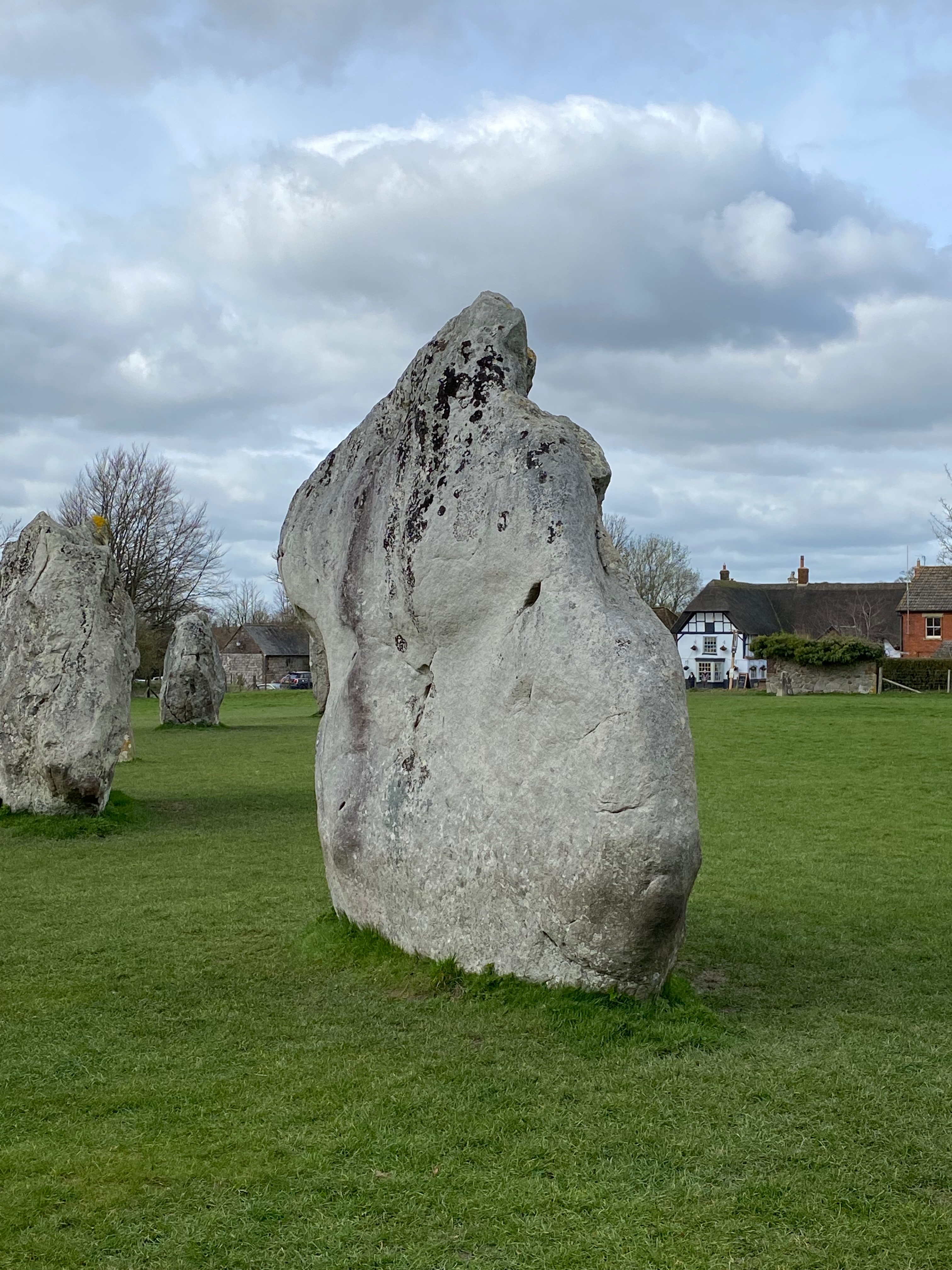
I remember listening to Neil Oliver’s podcasts about Avebury and Stonehenge – and being struck so profoundly by hearing that these massive, megalithic monument projects were also, in themselves, never finished and never intended to be “complete”. Especially at Avebury – a sacred site that’s an hour’s drive and a regular visit from where I’m currently living, just on the other side of the Salisbury Plains from Stonehenge, which is only 20 minutes from my home. It’s the largest Neolithic stone circle in the world and its enormous enclosing ditch was never – at any time in its five-millenia history – complete. The ditch took so long to dig out that the earlier parts were caving in by the time the last part was dug. And they never went back to fix it. Neil Oliver suggests that the purpose was in the making itself. Generations and communities, living and working and creating together. For the sake of creating. For the act of creating.
Like in Carolyn Hillyer’s Sacred House. Generations of women, of ancestors, of mothers, of grandmothers, of daughters. Creating and weaving and spinning and telling and retelling and participating in the narrative of the world they are making.
The 3 of Pentacles. The Wyrd Sisters. The ones who weave the threads of the stories that we tell and retell. The threads of the narrative of the world we create. The threads of the texts. The texts are the tantras. The sutras and the tantras. The threads and the texts. The fabric of the world we weave. The singing and the songlines. The leys and the leylines.
When we create, we collaborate with the weaving of the world.
In fact – you’ll have heard me saying this – we’re all always already doing that anyway. But most of the time we’re preoccupied with recreating the world we’ve always known and believed in – the world that got codified and fixed in form with those printed texts and the printing press and the ideas of the patriarchs and capitalists and colonialists and misogynists and racists. The ideas that got set down in books and reified in our imaginations as “the way things are” and “the way things have always been”.
It took a lot of violence and power and domination and oppression and the purposeful eradication of many, many lives and ways of living to shape and control that narrative and to fix it into form.
Now, in honour of the ones who walked before, I open and commit myself to Rewilding Writing – to speaking my truth and threading my words into the weaving of a new world and a new way of being and to share this path with as many people as are willing to step up and participate. So many are already walking it. And we are surrounded and supported by all those who have walked before, all those who are now walking, and all those who walk in front of us to guide our way from the future – where their very lives depend upon us to weave new paths.
Why write in times of absolute crisis and uncertainty?
Because to write is to create. And to create is to intentionally participate in the weaving of new worlds.
That’s why.
~
This Post Reweaves Words and Ideas from:
Hillyer, Carolyn (2010). Sacred House: Where Women Weave Words into the Earth. Braided River Books, Dartmoor. 2020 edition.
Larsen, Celeste (2023). Heal the Witch Wound: Reclaim Your Magic & Step Into Your Power. Weiser Books, Newburyport, MA.
Oliver, Neil (2020). ‘The World’s Largest Stone Circle – Avebury, Wiltshire’ from The History Podcast with Neil Oliver: Episode 12; 11 August 2020.
 Sally-Shakti Willow